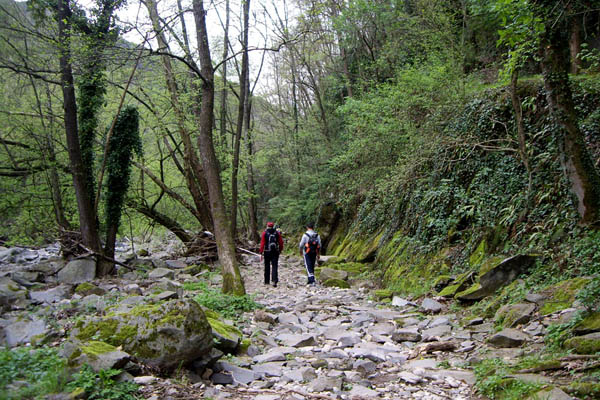
Mas Molera is located in the Begudà volcanic area, within the Garrotxa Natural Park, and is surrounded by very old oak trees and elms, fields and meadows.
Begudà has got a notable historical heritage, still appreciated in the 12th century Romanic Santa Eulalia church, its surrounding manor houses and a nearby pointed-arch bridge.
Begudà is a district in Sant Joan les Fonts municipality, within the Olot-Garrotxa county. This area is predominantly hilly and the Fluvia river runs along the valley.
Sant Joan les Fonts and the Garrotxa Volcanic Natural Park
Sant Joan les Fonts is the second town in population of the county and its name comes from the many springs and fountains of the area (“Fonts” meaning “Fountains”). The more prominent volcanic formations in Sant Joan les Fonts include Puig Aiguanegra and Can Repassot, located south of the town.
Sant Joan les Fonts has its origins back to the 9th century, but its first standing monument, the medieval bridge, was built around the 12th century. Another interesting place is Estada Juvinyà an old knight’s house and mill built in the 11th century and one of the better preserved examples of civilian medieval constructions in Catalonia. The Monastery of Sant Joan les Fonts is also worth a visit: constructed in Romanic style in the medieval ages, it has been reformed many times and some of the structures date back to the 18th century.
However the most interesting site to visit in Sant Joan les Fonts is Molí Fondo (“Deep Mill”): an old paper mill ruins next to three well-defined lava set flows in a breathtaking landscape by the Fluvià River. These lava set flows come from different old eruptions of nearby volcanoes, being the older 700.000 years old and the younger 120.000.
Other sights of the town: Cingles de Fontfreda and volcanoes of Claperols, Sant Cosme, Aiguanegra, Repàs, Repassot and Cairat.
Our cultural suggestions:
ESTADA JUVINYÀ MEDIEVAL HOUSE
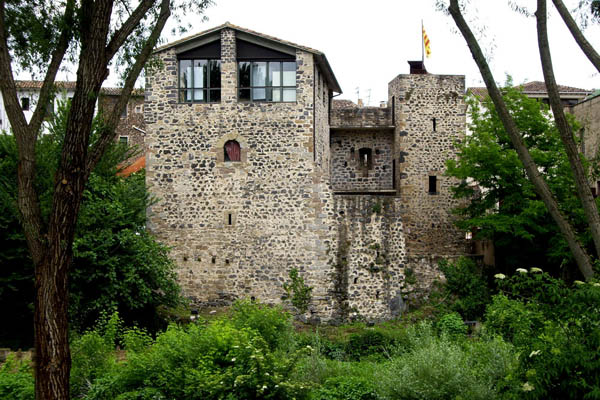
The medieval fortified manor house belonged to the Juvinyà dynasty of knights and today hosts the Territorial Interpretative Center. In 1972 it was listed as Monument of National Interest.
From the main wall, you can well observe the two sections constituting the building: the 12th century tower and the rest of the house dated from the 14th century. A water channel is surrounding the tower, which back in the 13th century was used to power the machinery of the flourmill.
A pedestrian itinerary:
“TRES-COLADES ROUTE” BASALT CLIFF IN SANT JOAN LES FONTS
The walk goes along an interesting area of basalt cliffs formed as the result of the cooling of streams of lava coming from different volcanoes. There are also riverside forests with species of high botanical value and some standing examples of 19th century industrial architecture by the riverbank.
MOLÍ FONDO – 3 km from Mas Molera
Here you can see three solidified streams of lava. The oldest one coming from the volcanoes of Batet and is 600.000 years old. The second one, that forms the basalt mosaic, has an unknow origin and was formed 150.000 years ago, and the youngest one (comes from the Garrinada volcano and is about 120.000 years old.
EL BOSCARRÓ
El Boscarró is a former basalt quarry that stopped its works at the beginning of the 20th century. Basalt results from cooling of streams of lava and is a hard, isolating and corrosion-resistant stone that has been extensively used for paving stones. During the cooling process of lava, basalt takes different shapes, like prism and lens. Long centuries of erosion have uncovered the cliffs of Fontfreda now turned into a resort area. Beyond this point, the itinerary goes across the river along a stone passage and runs some meters by the left bank to go back, later, to the right bank.
Access: The itinerary starts at the Plaça Major of Sant Joan les Fonts. El Molí Fondo and El Boscarró are 800 m (20 minutes) away, the whole itinerary is 5.5 km (1 hour and 50 minutes).